BLOGHOSTS
No Result
View All Result
  • Home
    • Home – Layout 1
  • Business
  • Computers
  • Fashion
  • Finance
  • General
  • Home
    • Home – Layout 1
  • Business
  • Computers
  • Fashion
  • Finance
  • General
No Result
View All Result
BLOGHOSTS
No Result
View All Result
Home Technology

Why No Two Apps Agree on the Price of Bitcoin

Share on FacebookShare on Twitter

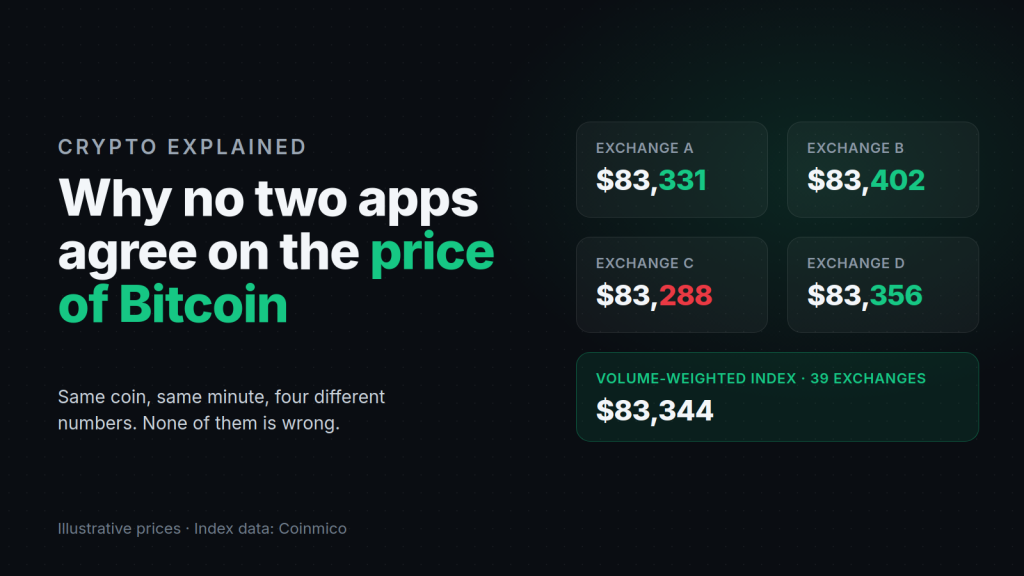
A friend of mine recently sent a group chat into mild chaos. He had screenshotted the Bitcoin price on his banking app, his brother had screenshotted it on a trading app, and a third person had googled it. Three screenshots taken within the same minute, three different prices, roughly £60 apart. Someone asked the obvious question: which one is the real price?

There is no single “real” price

The honest answer, which took me an evening of reading to accept, is that there is no single real price. Bitcoin is not like a FTSE share that trades on one exchange with one official closing figure. It trades around the clock on hundreds of venues at once, from large regulated exchanges in the US and Europe to small platforms in South Korea, Turkey or Indonesia, and on decentralised exchanges that are just software running on a blockchain. Each venue has its own buyers and sellers, so each one has its own price at any given second. They stay close to each other because traders profit from any gap, but they are never identical.

Every app picks its own method

So when an app shows you “the” price, someone has made a decision about how to calculate it. Some apps simply show the price from one exchange, usually the one they are partnered with. Some take an average across a handful of big venues. The better data sites take a volume-weighted average: an exchange where millions of pounds change hands every minute counts for more than one with a few sleepy trades, which stops a tiny platform with a stale or odd price from dragging the number around.

Currency and timing add to the gap

Currency makes it messier still. A lot of Bitcoin trading happens against the US dollar or against so-called stablecoins, digital tokens pegged to the dollar. If you are looking at a price in pounds, the app has converted it using an exchange rate of its choosing, and on a volatile day that rate alone can explain a chunk of the difference.

Then there is timing. Crypto prices update every second. One app might refresh every ten seconds, another every minute, a search engine’s snippet may be a few minutes old. Your “same minute” screenshots were not really simultaneous.

Why the method matters more than the number

None of this means the numbers are made up. It means a price is only meaningful if you know how it was built. This is the part I found genuinely interesting. The more transparent data sites publish their method. Coinmico, an independent market data site I ended up using for this article, lists the exchanges it pulls from (39 at the time of writing, covering more than 28,000 trading pairs), explains that its price is a volume-weighted index, and even flags the venues it excludes because their reported volume does not look real. Whether or not you care about crypto, that is more disclosure than most consumer apps offer about anything.

What to do about it

For an ordinary person who just wants to know roughly what Bitcoin costs, the practical lesson is simple. Pick one source and stick with it, so you are at least comparing like with like from day to day. Prefer a source that averages across many exchanges rather than one. And if you are about to actually buy, ignore every app and look at the price on the exchange you are buying from, because that, plus its fees, is the only price that will touch your bank account.

As for the group chat: all three screenshots were correct, and the £60 gap was smaller than the fee one of them would have paid to buy. If you want to see how different the venues can be, Coinmico’s exchange rankings show the price and volume on each one side by side; it is an oddly satisfying thing to watch for a minute.


Previous Post

A Practical Content Growth Plan for Small Businesses

Next Post

Sustainable Commercial Clearance: What Really Happens to the Waste Businesses Leave Behind?

Next Post
Sustainable Commercial Clearance: What Really Happens to the Waste Businesses Leave Behind?

Sustainable Commercial Clearance: What Really Happens to the Waste Businesses Leave Behind?

No Result
View All Result
Sustainable Commercial Clearance: What Really Happens to the Waste Businesses Leave Behind?

Sustainable Commercial Clearance: What Really Happens to the Waste Businesses Leave Behind?

by Dany Michael
8 October 2026
0

There is a particular moment during the refurbishment of a commercial building when the scale of what is being discarded becomes impossible to ignore. The desks have been disconnected, the shelving dismantled and the cupboards emptied. What once looked like a functioning workplace is reduced to piles of furniture, electrical equipment, packaging and materials that nobody wants to take to the new premises. Standing in the middle of it all, a business owner might reasonably wonder where everything is going to end up. A few weeks earlier, these objects were part of the ordinary working environment. Employees sat at the desks, stored documents in the cabinets and used the equipment without giving much thought to its eventual disposal. Now the same items have become a logistical problem, one that needs to be resolved before contractors can begin work or the keys can be returned to the landlord. For businesses across Glasgow, this situation is increasingly familiar. Offices are being reorganised to accommodate different working patterns, retail premises are changing hands and industrial units are being adapted for new occupiers. Furniture and equipment that once served a useful purpose can become redundant almost overnight. The environmental consequences are rarely visible at the point of collection. A vehicle arrives, unwanted contents are loaded and the premises are left empty. From the perspective of the business, the problem has been solved. But removal is not the same as responsible disposal. Every discarded desk, damaged chair, redundant printer and dismantled shelving unit has a material history. Resources were extracted to manufacture it, energy was used to produce and transport it, and further resources may be needed to process it when its working life ends. Some of those materials can be recovered. Others may be suitable for reuse without significant processing. A proportion will require specialist treatment, while certain items may have limited recovery options. The decisions made during commercial clearance influence which of those outcomes becomes possible. Sustainability in this context is not simply about arranging for a recycling vehicle or choosing a contractor with environmental language on its website. It begins much earlier, when a business decides what it genuinely needs to discard and whether the remaining contents have another useful life. The Problem With Calling Everything Waste Consider a medium-sized Glasgow company preparing to leave an office it has occupied for twelve years. The business has decided to move into smaller premises, reflecting a workforce that now divides its time between home and the office....

Why No Two Apps Agree on the Price of Bitcoin

by Dany Michael
8 October 2026
0

A friend of mine recently sent a group chat into mild chaos....

A Practical Content Growth Plan for Small Businesses

A Practical Content Growth Plan for Small Businesses

by Dany Michael
23 September 2026
0

For a small business, getting noticed online can feel like a second...

The Setup Process for WhatsApp Web Is Also Very Simple

The Setup Process for WhatsApp Web Is Also Very Simple

by Dany Michael
17 September 2026
0

WhatsApp has become an important communication tool for people around the world....

How Rising Household Bills Are Changing Spending Habits Across the UK

How Rising Household Bills Are Changing Spending Habits Across the UK

by Dany Michael
15 May 2026
0

Rising household costs continue to shape the way people across the UK...

Categories

  • Automobiles (2)
  • Beauty (3)
  • Business (23)
  • Construction (2)
  • E-commerce (2)
  • Education (2)
  • Entertainment (33)
  • Fashion (10)
  • Finance (5)
  • Food (1)
  • Games (2)
  • General (104)
  • Health (9)
  • Home and Family (14)
  • Law (2)
  • Lifestyle (2)
  • Marketing (5)
  • Photography (2)
  • Real Estate (2)
  • Sports (1)
  • Technology (24)
  • Travelling (9)
  • Web-development (5)
  • About
  • Contact

© 2023 BlogHosts.com

No Result
View All Result
  • Home
    • Home – Layout 1
  • Business
  • Computers
  • Fashion
  • Finance
  • General

© 2023 BlogHosts.com